
Conflict among team members is inevitable especially when the stakes are high and opinions diverge on key strategic matters. While healthy conflict can fuel innovation and lead to stronger decisions, tensions can quickly turn personal, damaging trust and collaboration.
|
This post introduces a powerful framework The Ladder of Conclusions to help leaders recognize when team members are interpreting situations through biased perceptions rather than facts. It explains how people climb this “ladder” from observation to conclusion, often forming inaccurate beliefs about others that deepen conflict.
|
Leaders play a critical role in helping team members “come down the ladder” by guiding them through five intentional steps: Connect, Share Stories, Discover Impact, Discover Ripple Effect, and Partner. These steps promote understanding, empathy, and accountability, allowing colleagues to rebuild trust and move forward productively.
|
Ultimately, this approach not only resolves immediate conflict but also teaches individuals to recognize their own triggers reducing the likelihood of future breakdowns and strengthening the team’s overall resilience and cohesion.
•••
As a leader you will inevitably find yourself with team members who are in conflict over a high stakes matter. It may be formulating a breakthrough strategy, dealing with a new competitive threat, whether to go forward with an acquisition or what to do about a non-performing division.
These situations are all worthy of argument to ensure you get to the best ideas. That’s called healthy conflict and it’s what Patrick Lencioni says is better than no conflict at all.
Yet there are those times when people start getting upset with the other person over the way they think or approach the conversation altogether. It starts to feel personal at a time like that. Once it feels personal, people may say or do things that aren’t collegial and may begin to fracture a once functioning relationship.
What do you do then?
Let’s look at a tool that may help in situations like these that seem fragile and hard to navigate.
The first tool is called the Ladder of Conclusions. It describes what happens when someone starts reading more into a situation than what may be actually occurring.
You see, when we encounter another person and we perceive them negatively due to something they’ve said or shown through an expression, we have a bio-reaction. This can happen in seconds. It’s so quick we can hardly stop it. That bio-reaction then leads to feelings.
After that is when thoughts enter the picture. These thoughts are based on our negative feelings and are intended to help us make meaning out of what we’re hearing or seeing.
Where it gets dangerous is when our thoughts lead to beliefs about the other person that may not be true. And worst of all, we draw a conclusion from our reading of the situation.
“I can’t trust this person.” 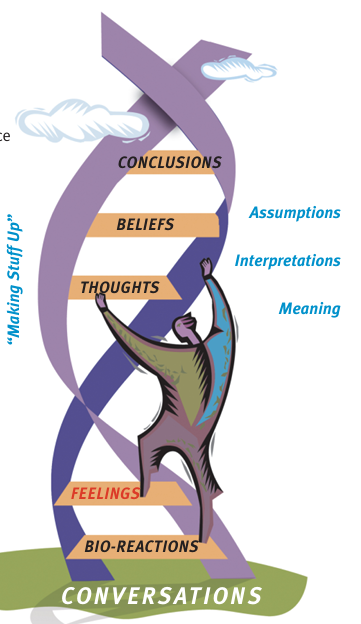
“I can’t work with them.”
“They are so stubborn.”
“They just don’t get it.”
It’s really hard to come down the ladder without help. This is where you come in as an objective and neutral leader who wants to help them come down the ladder.
By looking at the pdf, you’ll see the five steps to take to help both parties come down the ladder – Connect, Share Stories, Discover Impact, Discover Ripple Effect, then Partner to discuss how you’ll do things differently in the future.
This tool can be effective when you are hearing the two people embroiled in the conflict describe the other party in ways you don’t believe are grounded in reality. When your intuition is telling you that they are going up the ladder, use this tool to help them come down.
Be sure before you even try to help them that you are clear they both want your help to resolve the issue. They want to contribute to making things better and have some sort of shared understanding of what they’d like to achieve by working better together.
They will also learn something important about themselves and how they go up the ladder when disagreeing vehemently with another person. It could help them to possibly stop from going all the way up the next time.
Get our monthly newsletter to receive relevant articles, resources and news. Instantly receive a guide on “Tips for Making Big Decisions with More Confidence!” when you subscribe.
Key Takeaways
-
Healthy conflict drives performance—but when disagreements become personal, relationships and collaboration suffer.
-
The Ladder of Conclusions explains how people jump from observations to assumptions to conclusions, often without realizing it.
-
Leaders must act as neutral facilitators, helping both parties see where their interpretations may have diverged from reality.
-
The five-step process—Connect, Share Stories, Discover Impact, Discover Ripple Effect, Partner—helps rebuild understanding and trust.
-
Before intervening, ensure both parties genuinely want to resolve the issue and improve their working relationship.
-
When used effectively, this tool not only resolves conflict but also helps team members develop greater self-awareness and emotional intelligence.
Download and complete this self-assessment to hone in on the specific areas to strengthen to increase your ability to communicate clearly and powerfully. Study our other resources and consider coaching to further your development. To further assist you, we’ve created the Building a Cohesive Team self-assessment to help you identify opportunities to strengthen collaboration, trust, and alignment within your team.
•••
Here are more resources related to teams:
Articles:
- Bridging the AI Disconnect with Your Team
- Team Coaching: What it is and how it works, in a nutshell
- 10 Powerful Benefits of Team Coaching
- Are you working in the team or on the team?
- How are your Teams Feeling Right Now? Measure the Emotional Culture
- The Role of Team Training in Building Company Culture
- Building Cohesiveness in Your Team: 10 Best Practices
Case Study:
- Case Study 3: Bringing a Team Together for Strategic Planning Success
- Case Study 6: Executive Coaching Helps a Young Leader Garner the Respect and Loyalty of Her Veteran Team
Videos:
- What to Do When Members of a Leadership Team Don’t Get Along?
- Could Team Coaching be Good for Your Leadership Team
Photo copyright: Featured photo is from ©Yan Krukau via Pexels.